Alzheimer Disease & Dementia > Evaluation & Diagnosis
Best Practice Guidelines for Reducing and Preventing Agitation in Individuals with Cognitive Impairment
Copy Link
The International Psychogeriatric Association Agitation Work Group has developed an integrated, algorithmic strategy for reducing and preventing agitation in individuals with cognitive impairment. The new approach emphasizes an “Investigate, Plan, and Act” (IPA) framework for all interventions (see Figure), which draws on data from randomized trials, clinical experience, published guidelines, and expert consensus.
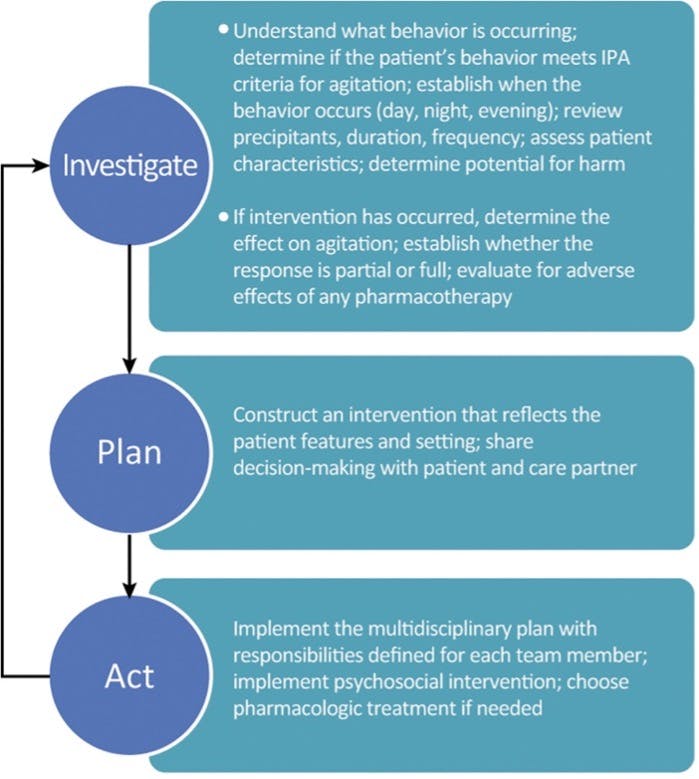
Figure. Investigate, Plan, Act (IPA) approach to agitation evaluation, management, and prevention. The process is repeated until the agitation is reduced to an acceptable level and prevention of recurrent episodes is optimized. The approach builds on the IPA definition of agitation in cognitive disorders (M de la Flor, PhD, illustrator).
Figure from Cummings J, Sano M, Auer S et al. Reduction and prevention of agitation in persons with neurocognitive disorders: an international psychogeriatric association consensus algorithm. International Psychogeriatrics, 2024;36(4):251-262.
The International Psychogeriatric Association Agitation Work Group consists of a multidisciplinary team, including specialists in the fields of geriatrics, psychiatry, neuropsychiatry, and nursing. The team conducted a review of literature on agitation management strategies, including key word and algorithm-focused studies, and compared current pharmacologic algorithms from sources such as the American Psychiatric Association and the Harvard South Shore Program.
The IPA algorithm includes the integration of psychosocial and pharmacologic interventions based on the patient’s unique needs and care setting and emphasizes the need for continuous reassessment of patients. Individualized, multimodal strategies that incorporate both patient and care partner participation are highlighted as particularly effective strategies for mitigating agitation. Pharmacologic treatment is reserved for situations in which psychosocial efforts alone do not achieve adequate results, with treatments tailored to the patient’s specific characteristics (eg, nocturnal/circadian agitation, mild agitation, severe agitation) and care environment (eg, home, nursing home, emergency department).
Additional details regarding the IPA framework can be found in the full article.
Additional details regarding the management of agitation in individuals with Alzheimer disease and Lewy body dementia can be found on Practical Neurology.