Multiple Sclerosis > Progressive Problems
Cognitive Dysfunction in Multiple Sclerosis
Consensus findings suggest all persons with multiple sclerosis should have cognitive assessments.
Copy Link
Cognitive difficulties are commonly experienced by people with multiple sclerosis (MS) and have a variety of presentations that are important to understand because of the real-world consequences of these symptoms. Assessments are available that are easy to use in clinical practice. Understanding the cognitive consequences of people’s cognitive difficulties can help them to make appropriate adjustments that can improve quality of life and treatments are in development.
Prevalence of Cognitive Impairment in MS
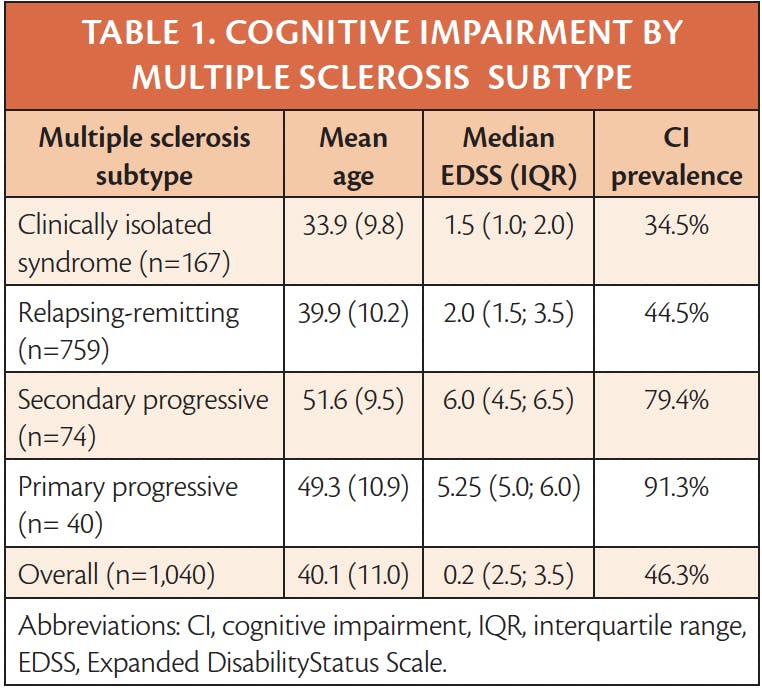
As shown in Table 1, in clinically isolated syndrome (CIS), the precursor to MS, approximately 1 in 3 people already have cognitive difficulties, and this increases to 44% in relapsing-remitting MS. This rises appreciably in the progressive forms of MS, almost as high as 80% in secondary progressive MS and even higher in primary progressive MS. Overall the prevalence of cognitive difficulties is approximately 46%.1
Cognitive difficulties increase as MS progresses. At diagnosis, the majority will not have cognitive impairment, but 1 in 4 have mild or moderate cognitive impairment (Figure 1).2 After 5 years of disease progression, this increases to 1 in 3, and approximately 10 years into disease progression, over half have mild to moderate cognitive impairment, defined as failing 3 to 5 subsets on neuropsychologic testing for mild impairment and failing more than 5 subsets for moderate impairment.
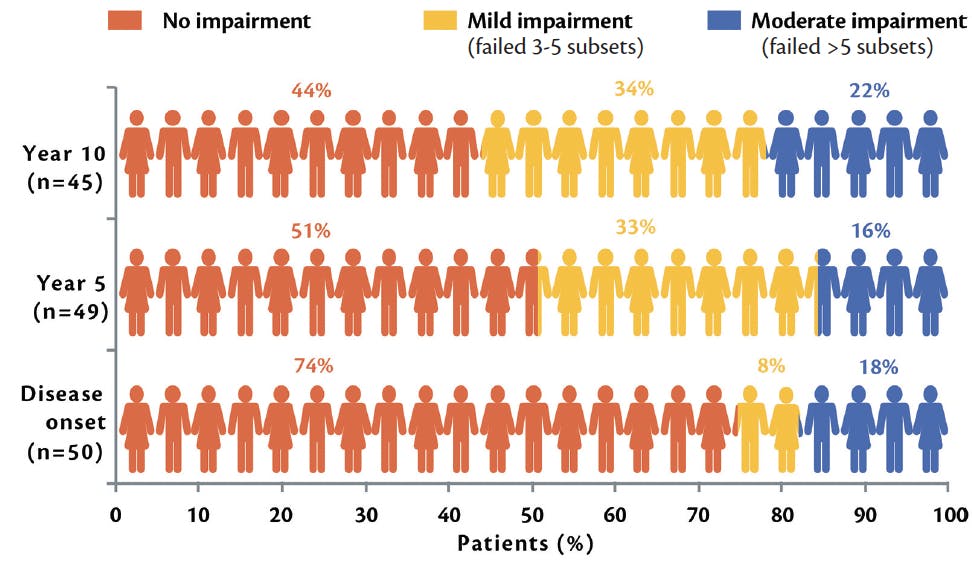
Figure 1. Over a 10-year period, the proportion of patients with multiple sclerosis (MS) who had cognitive impairment increased. Previously detected cognitive defects in verbal memory, abstract reasoning, and linguistic processes were confirmed on the third testing, at which time deficits in attention/short-term spatial memory also emerged. Disability level and degree of cognitive impairment were independent predictors of disability in the workplace and in social settings. Figure created by Biogen.
Clinical Presentation
The cardinal presentation of cognitive impairment in MS is delayed processing speed (Figure 2). Information processing speed slows down, and memory difficulties are also very common. Visual memory difficulties are more frequent than verbal memory deficits. Verbal memory deficits, both immediate and delayed, occur, and executive functioning is impaired. Concept formation, which refers to an aspect of executive functioning and visual perceptual abnormalities are also present.3
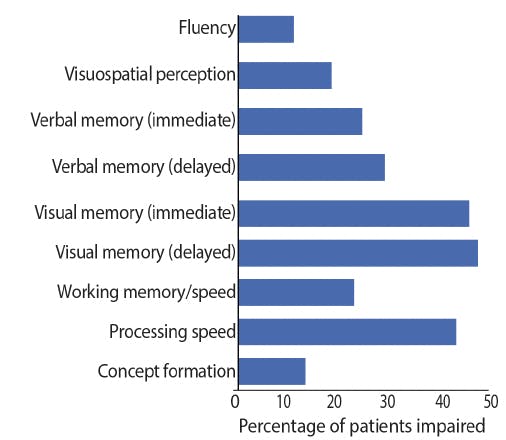
Figure 2. Cognitive deficits observed in persons with multiple sclerosis.
These problems affect activities of daily living from bathing to shelving food, opening containers, making beds, and more.4 Cognitive difficulties can also impede a person’s ability to self-manage their disease and remain adherent to treatment with disease-modifying medications (DMTs).5 The most common reason for individuals, not to use a DMT is because of their cognitive impairment—they simply forget to give themselves injections or take their pills. Other reasons for not taking medication include fatigue and depression.
Assessing Cognitive Impairment in MS
Neuropsychologic Screening & the Symbol Digit Modalities Test
Full neuropsychologic evaluations provide the best assessments of cognitive impairments but are unavailable to many because of the few numbers of trained neuropsychologists. Other options provide useful information, however, and are relatively easy to use in clinical practice. The MS Neuropsychological Screening Questionnaire [MSNQ] is a self-report screening questionnaire. Brief screening batteries include the Brief International Cognitive Assessment in MS (BICAMS) and the more detailed Minimal Assessment of Cognitive Function in MS (MACFIMS), which is recommended in consensus guidelines.
The commonly used Mini-Mental State Examination (MMSE) and Montreal Cognitive Assessment (MoCA), however, are not recommended for assessing cognition in MS because these lack sensitivity, likely because they do not have an index of processing speed.
MACFIMS is a comprehensive battery that evaluates verbal and visual memory, processing speed, visuospatial abilities and executive functioning. It takes about 90 minutes to complete for a healthy person and longer in a person with MS. BICAMS, in contrast, takes about 10 minutes to complete and tests processing speed and verbal and visual memory. BICAMS has been translated and validated in multiple languages and comprises the California Verbal Learning Test for verbal memory, Brief Visual Memory Test, and the Symbol Digit Modalities Test (SDMT). The SDMT has emerged as a particularly sensitive test for teasing out cognitive problems in people with MS.
Although full cognitive testing for people with MS is recommended, many argue that if you can do only 1 test for cognitive problems, it should be the SDMT,6 which can be taken in 90 seconds. Patients express preference for the SDMT because it is easy to complete, consisting of an image of 9 numbers and symbols at the top and a row of blank spaces with symbols at the bottom (Figure 3), which the patient completes by placing the appropriate number under each symbol at the bottom.

Figure 3. The Symbol Digit Modalities Test.
A caveat with the SDMT and neurocognitive testing in general that I and my team have been researching is the role of distractions during testing.7 Typically for cognitive tests, we try to create this ideal environment of silence, but this, of course, does not reflect the real world, which is full of distractions, noise, people moving around, and multiple things going on at once. We evaluated 100 people with MS and 100 people without MS or cognitive problems with a digital SDMT with and without distractors (ie, the sound of a car horn or a phone ringing). We also gave all participants the MACFIMS and intelligence quotient (IQ) tests. Across all participants, scores went down when the test included distractors, but there was a larger decrease in those with MS.
We have also found that scores on the SDMT under conditions with distractors are further affected by depression in people with MS. This is important because approximately half of people with MS will develop a major depression over the course of their lifetime and there is almost an additive effect of depression and distractions further impeding the person’s cognitive abilities. In contrast, anxiety does not have a large impact on cognition in people with MS under conditions with distractors.
Neuroimaging and Cognition in MS
Cerebral atrophy has emerged as a robust predictor of cognitive difficulties. In particular, thalamic atrophy is a robust marker of cognitive problems. The thalami sit on either side of the third ventricle, and when there is thalamic atrophy, the third ventricle appears widened. Asking neuroradiologists to evaluate the width of the third ventricle can be informative because the widening of the third ventricle may increase with MS disease progression.8,9
Treating Cognitive Impairment in MS
Meta-analysis has shown that medications (eg, donepezil, memantine, or rivastigmine) and complementary treatments (eg, ginko biloba) are not effective for treatment of cognitive impairment in MS.10 Cognitive compensation strategies (eg, list making tools or digital reminders and alarms) can be useful in helping individuals adapt to their cognitive deficits but do not improve cognitive impairment.
There is, however, emerging evidence that cognitive rehabilitation may be helpful,13-16 although replication of studies is still needed. In these studies, cognitive rehabilitation improved memory and processing speed, including when given in person individually or to groups or via computer applications. The focus of cognitive rehabilitation is either to slow the cognitive decline, or ideally, to bring about some cognitive improvement and the preliminary data now show that this is potentially possible. Individual research teams are also beginning to evaluate cognitive rehabilitation as an adjunctive therapy, for example in combination with exercise.
Summary
Cognitive dysfunction is common in MS, consisting predominantly of processing speed and memory deficits, which affect a person’s ability to carry out activities of daily living. Distractors in real-world settings expose more cognitive problems in people with MS, which is relevant for activities of daily living. Physicians should aim to establish a cognitive baseline as close to diagnosis as possible and provide serial testing to track patients’ cognitive symptoms. The Symbol Digit Modalities Test, is a 90 second evaluation that provides useful information. Brain MRI correlates of thalamic atrophy and third ventricle widening are also useful. Medications for cognitive impairment are not effective, but there is emerging evidence that cognitive rehabilitation can stabilize and even prevent cognitive decline.
1. Ruano L, Portaccio E, Goretti B, et al. Age and disability drive cognitive impairment in multiple sclerosis across disease subtypes. Mult Scler. 2017;23(9):1258-1267.
2. Amato MP, Ponziani G, Siracusa G, Sorbi S. Cognitive dysfunction in early-onset multiple sclerosis: a reappraisal after 10 years. Arch Neurol. 2001;58(10):1602-1606.
3. Benedict RH, Cookfair D, Gavett R, et al. Validity of the minimal assessment of cognitive function in multiple sclerosis (MACFIMS). J Int Neuropsychol Soc. 2006;12(4):549-558.
4. Rao SM, Leo GJ, Ellington L, Nauertz T, Bernardin L, Unverzagt F. Cognitive dysfunction in multiple sclerosis. II. Impact on iployment and social functioning. Neurology. 1991;41(5):692-696.
5. Devonshire V, Lapierre Y, Macdonell R, et al. The Global Adherence Project (GAP): a multicenter observational study on adherence to disease-modifying therapies in patients with relapsing-riitting multiple sclerosis. Eur J Neurol. 2011;18(1):69-77.
6. Benedict RH, DeLuca J, Phillips G, et al. Validity of the Symbol Digit Modalities Test as a cognition performance outcome measure for multiple sclerosis. Mult Scler. 2017;23(5):721-733.
7. Patel VP, Zambrana A, Walker LA, Herrmann N, Swartz RH, Feinstein A. Distractibility in multiple sclerosis: the role of depression. Mult Scler J Exp Transl Clin. 2016;2:2055217316653150.
8. Houtchens MK, Benedict RH, Killiany R, et al. Thalamic atrophy and cognition in multiple sclerosis. Neurology. 2007;69(12):1213-1223. doi:10.1212/01.wnl.0000276992.17011.b5
9. Minagar A, Barnett MH, Benedict RH, et al. The thalamus and multiple sclerosis: modern views on pathologic, imaging, and clinical aspects. Neurology. 2013;80(2):210-219.
10. He D, Zhang Y, Dong S, Wang D, Gao X, Zhou H. Pharmacological treatment for miory disorder in multiple sclerosis. Cochrane Database Syst Rev. 2013;(12):CD008876. doi:10.1002/14651858.CD008876.pub3
11. Chiaravalloti ND, Moore NB, Nikelshpur OM, DeLuca J. An RCT to treat learning impairment in multiple sclerosis: the MiREHAB trial. Neurology. 2013;81(24):2066-2072.
12. Chiaravalloti ND, Goverover Y, Costa SL, DeLuca J. A pilot study examining speed of processing training (SPT) to improve processing speed in persons with multiple sclerosis. Front Neurol. 2018;9:685.
13. Rilo O, Peña J, Ojeda N, et al. Integrative group-based cognitive rehabilitation efficacy in multiple sclerosis: a randomized clinical trial. Disabil Rehabil. 2018;40(2):208-216.
14. Mani A, Chohedri E, Ravanfar P, Mowla A, Nikseresht A. Efficacy of group cognitive rehabilitation therapy in multiple sclerosis. Acta Neurol Scand. 2018;137(6):589-597.
15. Messinis L, Nasios G, Kosmidis MH, et al. Efficacy of a computer-assisted cognitive rehabilitation intervention in relapsing-riitting multiple sclerosis patients: a multicenter randomized controlled trial. Behav Neurol. 2017;2017:5919841.
16. Pedullà L, Brichetto G, Tacchino A, et al. Adaptive vs. non-adaptive cognitive training by means of a personalized app: a randomized trial in people with multiple sclerosis. J Neuroeng Rehabil. 2016;13(1):88.