Alzheimer Disease & Dementia > Evaluation & Diagnosis
Study Establishes Clinical Criteria for Limbic-Predominant Amnestic Neurodegenerative Syndrome
These criteria aim to assist with the differential diagnosis of progressive amnestic syndromes.
Copy Link
Study results published in Brain Communications validated clinical criteria for a limbic-predominant amnestic neurodegenerative syndrome (LANS), which enabled the differentiation of amnestic syndromes associated with Alzheimer disease neuropathological change (ADNC), limbic-predominant age-related TDP-43 encephalopathy (LATE-NC), or both pathologies. The majority of cases involving limbic system degeneration alone are caused by LATE-NC, whereas most cases of neocortical degeneration are caused by ADNCs. The significant overlap in clinical features associated with predominant limbic degeneration and neocortical degeneration has made it difficult to distinguish between etiologies associated with amnestic syndromes. The implementation of these criteria may assist with the differential diagnosis and treatment of progressive amnestic syndromes.
The LANS criteria incorporate core, standard, and advanced features, including older age, mild clinical syndrome, disproportionate hippocampal atrophy, impaired semantic memory, limbic hypometabolism, and absence of neocortical degeneration (see Table). Clinical, imaging, and biomarker data were used to validate the association of these criteria with clinical and pathologic outcomes. Researchers applied the criteria to autopsied patients from the Mayo Clinic and Alzheimer’s Disease Neuroimaging Initiative (ADNI) cohorts who had antemortem predominant amnestic syndrome and evidence of ADNC, LATE-NC, or both pathologies at autopsy (N=218). A logistic regression model using the criteria features as predictors of TDP-43 pathology was developed and tested for accuracy in both cohorts.
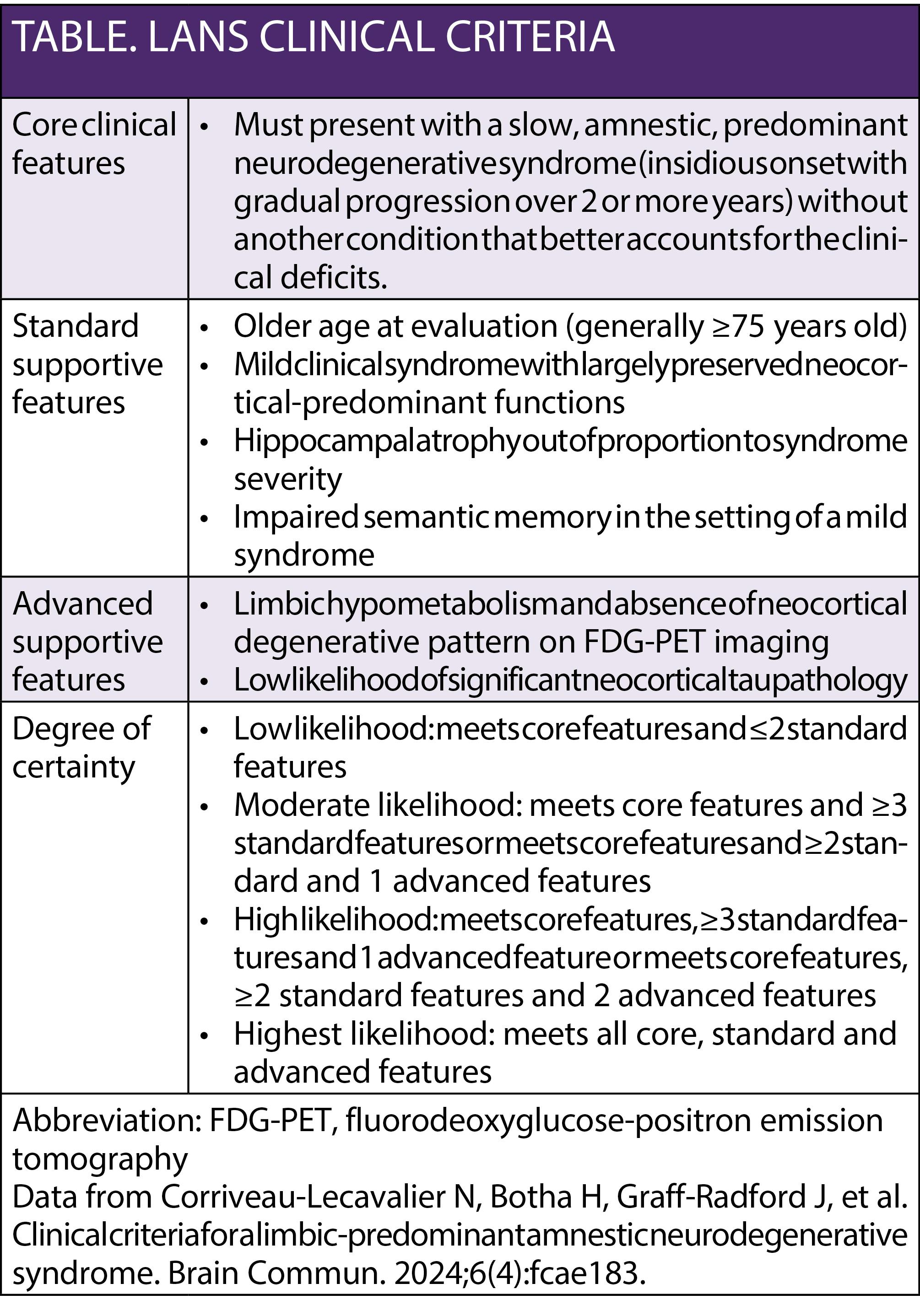
The criteria effectively differentiated cases of ADNC, LATE-NC, and both pathologies, with ADNC patients having the lowest LANS likelihoods, LATE-NC patients having the highest likelihoods, and patients with both pathologies having intermediate likelihoods. The logistic regression model achieved a balanced accuracy of 74.6% in the Mayo cohort and 73.3% in the external ADNI cohort. Patients with high LANS likelihoods demonstrated milder and slower clinical progression and more severe temporo-limbic degeneration compared to those with low likelihoods. Among patients with both ADNC and LATE-NC, those with higher LANS likelihoods showed more temporo-limbic degeneration and slower decline, while those with lower likelihoods exhibited more lateral temporo-parietal degeneration and faster decline.
Source: Corriveau-Lecavalier N, Botha H, Graff-Radford J, et al. Clinical criteria for a limbic-predominant amnestic neurodegenerative syndrome. Brain Commun. 2024;6(4):fcae183.