The Digital Education Lab: Your key to peer insights on KESIMPTA
Tap into the RMS experts and unlock the answers to your questions on KESIMPTA
This information is intended for US health care professionals only.
This information is intended for US health care professionals only.
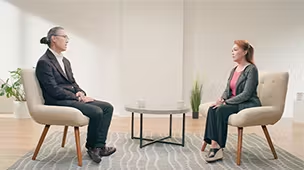
Douglas Jeffery, MD, and Stephanie Niemi-Olson, FNP
 Replay
:5
Cancel 
Copy Link
Like
Through patient cases and discussion, Stephanie Niemi-Olson, FNP, and Dr Douglas Jeffery share how they uncover patient preferences for treatment, address adherence issues, and help patients feel comfortable with KESIMPTA self-injections.
View Transcript +
Stephanie
When choosing a disease-modifying therapy for relapsing multiple sclerosis, or RMS, patients, we often focus on what they need from a clinical perspective to control the disease with minimal or manageable side effects. However, our patients' unvoiced opinions or challenges, especially those regarding route of administration and dosing frequency, can impact their ability to adhere to our treatment plan and ultimately control their disease.
Dr Jeffery
* You brought up a good point that if we don't get patient buy-in or fail to understand the challenges our patients face taking treatment, our care might be suboptimal. In my experience, involving patients in their RMS care helps both the patient and the health care professional. Patients are looking to me for a plan that can help achieve their goals, and they want to know up front how we can handle potential obstacles, such as disease activity or side effects of treatment.
* Stephanie, what are your thoughts?
Stephanie
* In my opinion, partnering with people in their care is naturally integrated with asking patients questions to uncover their preferences for treatment.
* What I typically do is give them my assessment of their disease process. And if they have an active disease process or if they have a slower disease process, I talk to them about the therapies that are available for them and the pros and the cons of each therapy. I ask them questions like: What route of administration do you prefer? What do you want to avoid in terms of medications? Which of these treatments do you prefer? We also talk about the convenience of certain DMTs and about their safety profiles.
In that process, I find that some people want to make a switch from their current medication. For example, they might tell me they cannot take a daily pill because they cannot remember to do so. Or some of my patients who have been taking injectables for a while say that they don't want to inject themselves anymore or can't tolerate them. Or I have patients who live out of town, and they can't come in for their infusions because they live far away. In those cases, I suggest alternatives. It's important to understand and consider which route of administration a patient is willing to take.
Dr Jeffery
* Do you have an example you can share?
Stephanie
* Yes I do. I had a patient in her mid 30s who we suspected was not taking her medication due to missed visits and follow-up appointments. She eventually came back to us after a year because she developed discoordination and blurred vision, and an MRI revealed a new T2 lesion.
* Because she wasn't filling her prescriptions, we confirmed what medication she last noted taking and asked if she was still taking it. She was honest; she admitted to forgetting to take it. And so, we decided to reevaluate her treatment.
* There are lots of reasons for patients to become noncompliant. In my experience, a common reason is that they move away and lose touch with their doctor or health care system where they get their infusions.
Dr Jeffery
* That sounds like a difficult case. What did you do next?
Stephanie
* Well, the next step was deciding what type of medication would be most appropriate for her to take and didn't require her to find an infusion center.
* When I asked her about a monthly dosing option after an initial dosing period, she felt that would be much easier for her to remember than a daily pill. I recommended KESIMPTA because the Sensoready® Pen itself doesn't look reminiscent of a needle, which she appreciated. So we both agreed we should try this option.
Dr Jeffery
* And how is she doing now?
Stephanie
At the beginning, she was a little nervous about injecting herself. But after the first month of starter doses, she started feeling more confident and was happy she could do it on her own and take charge of her own care. It helped that the Sensoready® Pen did not look like a needle and that the injection was brief.
Dr Jeffery
* That's a good point, Stephanie. My patients tend to prefer one route of administration over another, especially when deciding between an injection versus an infusion.
* KESIMPTA is indicated for the treatment of relapsing forms of multiple sclerosis (MS), to include clinically isolated syndrome, relapsing-remitting disease, and active secondary progressive disease, in adults.
* Some of my patients also prefer the monthly self-administration of KESIMPTA.
You can see Important Safety Information on KESIMPTA within this video and on the adjacent panel.
Dr Jeffery
* Your case is interesting because I sometimes have patients who don't like the idea of injecting themselves or may be scared of potential injection-related side effects. Naturally this could come up with KESIMPTA because it is self-administered therapy.
* Stephanie, in your experience, how do you address these fears for your patients or explain why KESIMPTA is different?
Stephanie
* Some patients need a little handholding. So we reassure them that our lines of communication are open and that there are many ways to message me at any time if they have any questions about the injection or otherwise.
* During my conversations with patients, I typically ask them if they are hesitant about needles. And if they are, I reassure them that, from the feedback I've gotten from my patients, they don't have to see the needle. What I have observed is that the KESIMPTA autoinjector device, called the Sensoready® Pen, does not actually look like a syringe, which seems to help a lot with patients.
In cases where they need additional support, I recommend having one of their family members administer the injection. Most people are willing to help their loved one like that.
Dr Jeffery
* To your point, Stephanie, the fact that the injection device has a hidden syringe is helpful.
* I also tell them that any time they have a concern or are having a reaction, they can pick up the phone and give me a call. I may be able to do something about that.
* Ultimately, I haven't had a patient who was too scared to use it once I showed them how it works.
* 99.8% of injection-related reactions were mild-to-moderate in severity, and the most frequently reported symptoms greater than or equal to 2% included fever, headache, myalgia, chills, and fatigue.
Stephanie
* Some patients need that type of demonstration or follow-up. Any time that I administer an injection of anything, I let my patients understand that it can irritate the skin and cause redness and tell them that injection-site reactions are not uncommon with injections.
* I also recommend pinching out an inch or just warning them that some injection sites are more sensitive than others. I personally recommend trying different injection sites to see which one is less irritating.
And While there was only limited benefit of premedication observed in the RMS clinical studies, in my experience, some people are quite sensitive to injections. I ask them to tell me what their symptoms are, and if they get itchy or if it bothers them. I typically tell them to try leaving it alone at first or, if that's not possible, to use an over-the-counter medication or ice pack.
Dr Jeffery
* I know some physicians have concerns with adherence when we send patients home to self-administer. I ask my patients directly if they are taking their medication and they typically tell me.
Stephanie
* Yes, I think communication with the patient is the biggest factor when monitoring and encouraging adherence. I also want to see my patients initially at least every 3 months or sooner if they have any concerns.
* At these appointments, we ask the patient to provide us with an update by asking them a set of questions about issues that may impact adherence: How is the medication working for you? Are there any problems with the injection? Does it hurt? Do you feel sick?
* It is usually an informal conversation. Sometimes it can even be a telehealth appointment, especially if the patient lives way out of town.
* And when they answer these questions or express some hesitation, it helps me learn if they have skipped or missed medication. We then have a conversation about what is working well for them and what we can do to make it work better.
* Once patients begin taking KESIMPTA, it is important to assess if the patient is adhering well to the medication course. I keep emphasizing to my patients that suddenly stopping medication could put them at a risk for relapse.
Dr Jeffery
* I've also needed to discuss that with my patients. Occasionally, a patient may try to delay a KESIMPTA dose due to the risk of infection. I have to explain that delaying or skipping a dose won't reduce your risk of infection and that it might decrease the effectiveness of the drug, meaning your RMS symptoms may come back. It's important to continue taking KESIMPTA as recommended.
* We see our patients every 3 months and remain vigilant about their disease.
* When their disease activity is under control, my patients typically feel better and that motivates them to continue taking KESIMPTA.
Stephanie
* All my patients know that routine scheduling and check-ups are important for RMS care. We have a system in place at my practice to make sure our patients don't become lost to follow-up or disappear on us. We always schedule our next appointment while the patient is still in the office.
If a patient cancels an appointment, we call them back right away to understand why and reschedule. In addition to regular monitoring of disease activity, this process also helps us determine if our patients are taking their medication regularly.
Stephanie
* However, sometimes our patients can't stay adherent because they have trouble getting their medications due to issues with the pharmacy or insurance. I tell them it's always a good idea to communicate with me if they are having trouble getting their medications. In these cases, I reassure them that we can do whatever we need to to help, through free samples or otherwise.
Dr Jeffery
* In those cases, the Bridge Program is great. I can send the patients home with a KESIMPTA starter sample before insurance covers it. This is critical because my patients want to feel better. So the sooner they start treatment, the better off they are likely to be in the long term once we suppress disease activity.
Stephanie
I agree! The AlongsideTM KESIMPTA patient support program has helped us in every single instance with access issues, especially with temporary coverage for up to 1 year for commercially insured patients while coverage is being worked out.
Dr Jeffery
* I think KESIMPTA has a simple onboarding process as well. After patients choose KESIMPTA, we do the paperwork and do their preliminary bloodwork right there in the office.
Stephanie
* That is a great point. With regard to the bloodwork, we run some lab tests to make sure there is no hepatitis B infection and quantify their immunoglobulins, in accordance with the KESIMPTA package insert. KESIMPTA is contraindicated in patients with active HBV infection.
Once the baseline lab test results are in, patients can come back the next day to get the medication. In my experience, the whole onboarding process is pretty fast.
Dr Jeffery
* Overall, I just think the flexibility of KESIMPTA really helps with patient buy-in. It also helps when my patients have a say in their treatment choices.
Stephanie
* I appreciate your insights here on adherence, Dr Jeffery. We spoke about how we reassure patients about the safety profile of KESIMPTA, including injection-related reactions. But occasionally patients ask me about rare side effects, such as PML or cancer. How do you approach this conversation?
[Transition to fade...conclusion implies you have to watch the next video to hear about rare side effects]
IMPORTANT SAFETY INFORMATION
Infections
* Delay KESIMPTA administration in patients with an active infection until the infection is resolved. Vaccination with live-attenuated or live vaccines is not recommended during treatment with KESIMPTA and after discontinuation, until B-cell repletion
Injection-Related Reactions
* Management for injection-related reactions depends on the type and severity of the reaction
Reduction in Immunoglobulins
* Monitor the level of immunoglobulins at the beginning, during, and after discontinuation of treatment with KESIMPTA until B-cell repletion. Consider discontinuing KESIMPTA if a patient develops a serious opportunistic infection or recurrent infections if immunoglobulin levels indicate immune compromise
Fetal Risk
* May cause fetal harm based on animal data. Advise females of reproductive potential of the potential risk to a fetus and to use an effective method of contraception during treatment and for at least 6 months after the last dose.
KESIMPTA Important Safety Information | Click here for full Prescribing Information, including Medication Guide.

KESIMPTA Important Safety Information | Click here for full Prescribing Information, including Medication Guide. ▾
IMPORTANT SAFETY INFORMATION
Contraindications: KESIMPTA is contraindicated in patients with active hepatitis B virus (HBV) infection, or history of hypersensitivity to ofatumumab, or life-threatening injection-related reaction to KESIMPTA. Hypersensitivity reactions have included anaphylaxis and angioedema.
WARNINGS AND PRECAUTIONS
Infections: Serious, including life-threatening or fatal, bacterial, fungal, and new or reactivated viral infections have been observed during and following completion of treatment with anti-CD20 B-cell depleting therapies.
INDICATION
KESIMPTA is indicated for the treatment of relapsing forms of multiple sclerosis (MS), to include clinically isolated syndrome, relapsing-remitting disease, and active secondary progressive disease, in adults.
Indication
KESIMPTA is indicated for the treatment of relapsing forms of multiple sclerosis (MS), to include clinically isolated syndrome, relapsing-remitting disease, and active secondary progressive disease, in adults.
Important Safety Information
Contraindications: KESIMPTA is contraindicated in patients with active hepatitis B virus (HBV) infection, or history of hypersensitivity to ofatumumab, or life-threatening injection-related reaction to KESIMPTA. Hypersensitivity reactions have included anaphylaxis and angioedema.
Warnings and Precautions
Infections: Serious, including life-threatening or fatal, bacterial, fungal, and new or reactivated viral infections have been observed during and following completion of treatment with anti-CD20 B-cell depleting therapies. The overall rate of infections and serious infections in KESIMPTA-treated patients was similar to teriflunomide-treated patients (51.6% vs 52.7%, and 2.5% vs 1.8%, respectively). The most common infections reported by KESIMPTA-treated patients in relapsing MS (RMS) trials included upper respiratory tract infection (39%) and urinary tract infection (10%). Delay KESIMPTA administration in patients with an active infection until resolved.
Consider the potential increased immunosuppressive effects when initiating KESIMPTA after an immunosuppressive therapy or initiating an immunosuppressive therapy after KESIMPTA.
Hepatitis B Virus: Reactivation: No reports of HBV reactivation in patients with MS treated with KESIMPTA. However, HBV reactivation, in some cases resulting in fulminant hepatitis, hepatic failure, and death, has occurred in patients treated with ofatumumab at higher intravenous doses for chronic lymphocytic leukemia (CLL) than the recommended dose in MS and in patients treated with other anti-CD20 antibodies.
Infection: KESIMPTA is contraindicated in patients with active hepatitis B disease. Fatal infections caused by HBV in patients who have not been previously infected have occurred in patients treated with ofatumumab at higher intravenous doses for CLL than the recommended dose in MS. Perform HBV screening in all patients before initiation of KESIMPTA. Patients who are negative for HBsAg and positive for HB core antibody [HBcAb+] or are carriers of HBV [HBsAg+], should consult liver disease experts before starting and during KESIMPTA treatment.
Progressive Multifocal Leukoencephalopathy: No cases of progressive multifocal leukoencephalopathy (PML) have been reported for KESIMPTA in RMS clinical studies; however, PML resulting in death has occurred in patients being treated with ofatumumab at higher intravenous doses for CLL than the recommended dose in MS. In addition, JC virus infection resulting in PML has also been observed in patients treated with other anti-CD20 antibodies and other MS therapies. If PML is suspected, withhold KESIMPTA and perform an appropriate diagnostic evaluation. If PML is confirmed, KESIMPTA should be discontinued.
Vaccinations: Administer all immunizations according to immunization guidelines: for live or live-attenuated vaccines at least 4 weeks and, whenever possible at least 2 weeks prior to starting KESIMPTA for inactivated vaccines. The safety of immunization with live or live-attenuated vaccines following KESIMPTA therapy has not been studied. Vaccination with live or live-attenuated vaccines is not recommended during treatment and after discontinuation until B-cell repletion.
Vaccination of Infants Born to Mothers Treated with KESIMPTA During Pregnancy. For infants whose mother was treated with KESIMPTA during pregnancy, assess B-cell counts prior to administration of live or live-attenuated vaccines. If the B-cell count has not recovered in the infant, do not administer the vaccine as having depleted B-cells may pose an increased risk in these infants.
Injection-Related Reactions and Hypersensitivity Reactions: KESIMPTA can result in systemic injection-related reactions and hypersensitivity reactions, which may be serious or life-threatening. Injection-related reactions with systemic symptoms occurred most commonly within 24 hours of the first injection, but were also observed with later injections. There were no life-threatening injection reactions in RMS clinical studies.
In the post-marketing setting, additional systemic injection-related reactions and hypersensitivity reactions have been reported, including anaphylaxis, angioedema, pruritus, rash, urticaria, erythema, bronchospasm, throat irritation, oropharyngeal pain, dyspnea, pharyngeal or laryngeal edema, flushing, hypotension, dizziness, nausea, and tachycardia. Most cases were not serious and occurred with the first injection. Symptoms of systemic injection-related reactions may be clinically indistinguishable from acute hypersensitivity reactions.
The first injection of KESIMPTA should be performed under the guidance of an appropriately trained health care professional. If systemic injection-related reactions occur, initiate appropriate therapy. Patients who experience symptoms of systemic injection-related reactions or hypersensitivity reactions with KESIMPTA should be instructed to seek immediate medical attention. If local injection-related reactions occur, symptomatic treatment is recommended.
Reduction in Immunoglobulins: As expected with any B-cell depleting therapy, decreased immunoglobulin levels were observed. Monitor the levels of quantitative serum immunoglobulins during treatment, especially in patients with opportunistic or recurrent infections and after discontinuation of therapy until B-cell repletion. Consider discontinuing KESIMPTA therapy if a patient with low immunoglobulins develops a serious opportunistic infection or recurrent infections, or if prolonged hypogammaglobulinemia requires treatment with intravenous immunoglobulins.
Liver Injury: Clinically significant liver injury, without findings of viral hepatitis, has been reported in the post-marketing setting. Signs of liver injury have occurred weeks to months after administration. Patients treated with KESIMPTA found to have an alanine aminotransferase or aspartate aminotransferase greater than 3 times the upper limit of normal (ULN) with serum total bilirubin greater than 2 times the ULN are potentially at risk for severe drug-induced liver injury.
Obtain liver function tests prior to initiating treatment. Monitor for signs and symptoms of hepatic injury during treatment, including new or worsening fatigue, anorexia, nausea, vomiting, right upper abdominal discomfort, dark urine, or jaundice. If symptoms of liver injury are reported, measure serum aminotransferases, alkaline phosphatase, and bilirubin levels. Discontinue KESIMPTA if liver injury is present and an alternative etiology is not identified.
Fetal Risk: Based on animal data, KESIMPTA can cause fetal harm due to B-cell lymphopenia and reduce antibody response in offspring exposed to KESIMPTA in utero. Transient peripheral B-cell depletion and lymphocytopenia have been reported in infants born to mothers exposed to other anti-CD20 B-cell depleting antibodies during pregnancy. Advise females of reproductive potential to use effective contraception while receiving KESIMPTA and for at least 6 months after the last dose.
Most common adverse reactions: Most common adverse reactions (>10%) are upper respiratory tract infection, headache, injection-related reactions, and local injection-site reactions.
Please see full Prescribing Information, including Medication Guide.
KESIMPTA, the KESIMPTA logo, and SENSOREADY are registered trademarks of Novartis AG.

Use of this website is governed by the Terms of Use and Privacy Policy.
Copyright © 2026 Novartis Pharmaceuticals Corporation. All rights reserved.
1/26
FA-11589063